

The Panic of 1819: When America’s Postwar Boom Went Bust
A young nation’s first great test of credit and banking, and the arguments it started about who should carry the cost when easy money runs out.
In the years after the War of 1812, the United States seemed to be growing in every direction at once. Settlers poured into the Ohio Valley, the Mississippi Territory, and the Alabama lands that became a state in 1819. Cotton prices were high, banks were multiplying, and federal land was for sale on credit. Then, between 1818 and 1821, the boom gave way to falling prices, failing banks, lawsuits over unpaid debts, and lost work. The Federal Reserve Bank of New York has called this episode “America’s First Great Economic Crisis.”1
The Panic of 1819 is less a single event than a slow-motion collapse. No one woke up one morning in 1819 to find the economy in ruins. Instead, a series of pressures built up and then gave way across different regions at different times. That makes it harder to tell as a story, but it also makes it a useful one. It raises questions that Americans would ask again and again: what happens to ordinary people when a credit boom collapses, and whose job is it to help them?
The Postwar Boom
Paying for a War
The crisis’s roots reach back to the War of 1812. The federal government borrowed heavily to pay for the war, and suspended specie payments in 1814, meaning many banks stopped redeeming their paper notes in gold or silver coin.1 After the war, the Treasury also needed revenue to pay off debts tied to the Louisiana Purchase. One answer was to sell public land, much of it in the West and Southwest.
Congress also turned to a national bank. In April 1816, President James Madison signed an act creating the Second Bank of the United States, with a twenty-year charter.2 The new bank was meant to steady a currency system crowded with notes issued by many state-chartered banks. Its first president was William Jones.

Land Fever
During this period, demand for western land surged. Historian Andrew H. Browning, as summarized in economist Clyde Haulman’s review for the Economic History Association, reports that land sales in Alabama rose more than twentyfold between 1816 and 1818.3 Browning also notes unusual weather in the middle of the decade. After the 1815 eruption of Mount Tambora in present-day Indonesia, parts of New England experienced summer snow and drought, which raised grain prices and helped encourage westward migration.
Easy credit made the land rush possible. Federal law at the time allowed buyers to purchase public land in installments, paying a portion up front and the rest over several years. State banks, private banks, and branches of the Second Bank lent freely to buyers who expected land values and crop prices to continue rising. Economist Hugh Rockoff notes that the West “had been caught up in real estate speculation,” and that much of the land was “being purchased rapidly from federal land offices.”4
The Second Bank itself contributed to the expansion. The New York Fed’s account notes that the bank “undermined its own credibility by accepting IOUs for capital,” allowing investors to buy its stock on credit.1 Its western branches lent heavily, and because a note from any branch could be redeemed at any other, the costs of that lending could be shifted to branches in the East.
The boom also rested on costs that land prices and bank ledgers did not record. Much of the land being sold in Alabama had belonged to the Creek Nation. Under the Treaty of Fort Jackson, signed on August 9, 1814, at the end of the Creek War, the Creeks ceded more than 21 million acres to the United States.5 Federal agent Benjamin Hawkins objected that the treaty took nearly eight million acres from Creeks who had been allies of the United States. According to the Encyclopedia of Alabama, the ceded land “was opened to settlement and greatly expanded slave-based plantation agriculture.”
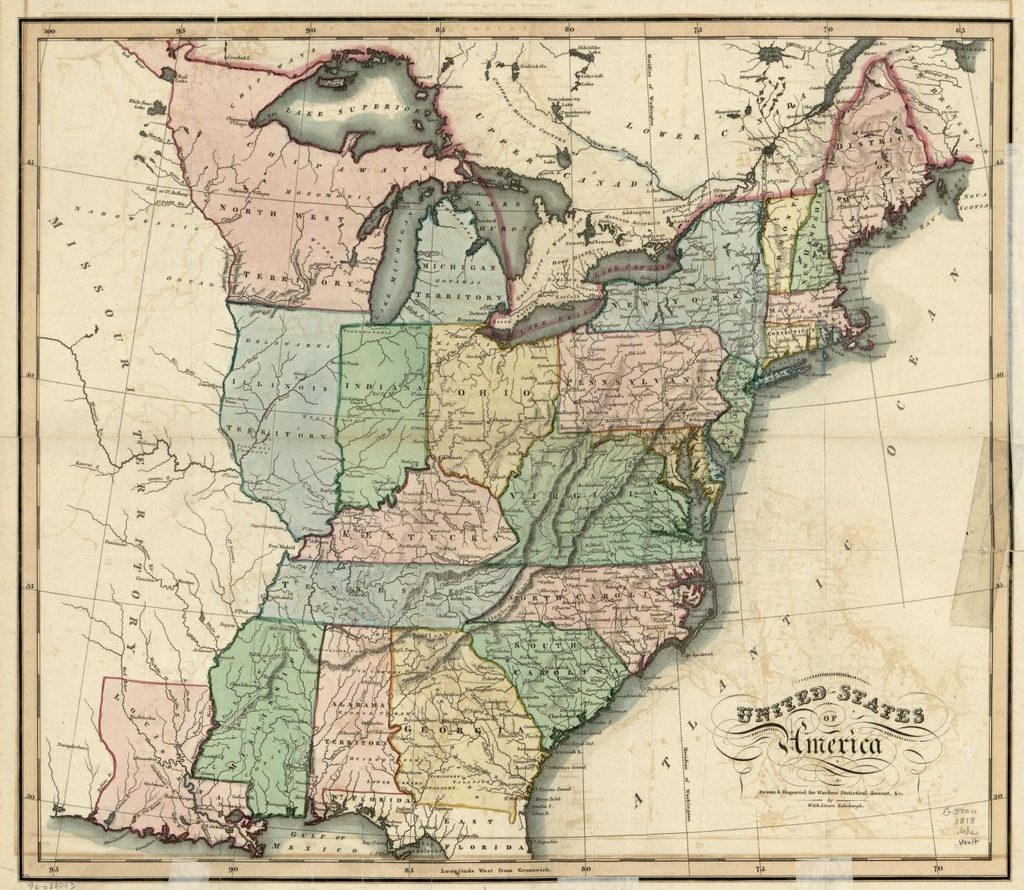
Cotton drove much of that expansion, and enslaved people produced it. Historian LeeAnna Keith writes that “the driving force behind Alabama Fever was the global demand for cotton cultivation stimulated by new industrial textile manufacturing processes.”6 She reports that roughly one-third of the migrants to Alabama were enslaved people, about 40,000 of whom were forced to move there between 1810 and 1820. Behind the cotton prices, land values, and debts in the rest of this story, the labor was largely theirs.
The Turn: 1818 and 1819
The Bank Pulls Back
By 1818, officials at the Treasury and the Second Bank were worried about the bank’s supply of gold and silver. According to Browning, as summarized in Haulman’s review, they were concerned about Louisiana Purchase bonds maturing in 1818 and 1819 that required payment in specie, mostly to foreign holders.3 Those payments would draw on the same scarce coin the bank needed to back its paper notes, and its reserves were already thin compared with the paper it had issued.
In July 1818, the Second Bank began restricting lending at its western and southern branches.4 As it pressed state banks for repayment in specie, those banks faced pressure to collect from their own borrowers. The contraction intensified a downturn already made more dangerous by land speculation, high debt, and falling crop prices. Rockoff describes the bank’s decision as “the spark that precipitated the suspension of specie payments in the West.” He also describes a federal land office ruling that fall, which allowed federal land to be paid for only in specie or Second Bank notes, not the notes of local banks.4 That ruling added to the squeeze on western banks and buyers.
Cotton Falls
At the same time, international demand and prices for American crops weakened. According to the New York Fed, cotton prices fell in January 1819, in part because British buyers turned to cheaper cotton from India, while better European harvests reduced demand for American farm goods.1 For planters and the merchants and banks that had lent to them, falling cotton prices meant that loans made in good times could no longer be repaid.
Leadership at the Second Bank changed as the crisis deepened. In March 1819, shareholders replaced William Jones with Langdon Cheves, an attorney from South Carolina.7 Cheves continued to tighten credit to protect the bank’s survival. The Federal Reserve’s historical essay on the bank concludes that its policies in this period “magnified the contraction in the United States.”2
Who Bore the Cost
Banks, Borrowers, and Courts
The collapse moved from banks to borrowers and back again. In Cincinnati, three chartered banks suspended payments, as did the Bank of the State of Kentucky, and banks in western Pennsylvania followed a similar path.4 Rockoff notes that the panic was most severe in the West, where the land boom had been largest.
For families, the crisis often arrived as a court summons. As prices and real estate values fell, the New York Fed explains, “over-indebted banks and homeowners went bankrupt.”1 The distress spread into farming and manufacturing and increased unemployment in towns and cities. Browning’s study uses individual stories to show how quickly bankruptcies and debt lawsuits multiplied, first in the East and then in the West.3 A farmer who had bought land on credit at a high price might now owe more than the land could fetch at auction. A merchant who had extended credit to customers might find that none of them could pay.
The surviving financial records tell mainly the story of borrowers, banks, and creditors. Others whose lives the boom shaped appear in them only indirectly, if at all. Enslaved people, treated in law as property, had no claim to the wealth their labor produced and no voice in the debts planters took on. Creek and other Native communities had already lost much of the land on which the speculation rested.
There is a further complication in measuring how bad it was. The federal government did not yet collect the kinds of statistics that later economists use to measure downturns. Contemporary accounts describe widespread distress, but some modern economic historians, working from reconstructed data, have questioned how severe the downturn was at the national level. That debate is taken up below.

What Could Government Do?
The States Respond
Because no federal relief system existed, much of the political response occurred in state legislatures. Many states passed debtor-relief measures. These included stay laws, which postponed debt collection, and minimum appraisal laws, which prevented property from being sold at auction for less than a set share of its assessed value.3 Some states also limited the chartering of new banks. Browning argues that the relief fights drew more ordinary voters into politics, as debtors and creditors organized on opposite sides.
These laws raised a hard constitutional question. The U.S. Constitution forbids states from passing laws “impairing the Obligation of Contracts.”8 Creditors argued that relief laws did exactly that. In Kentucky, the conflict became a constitutional crisis of its own. After the state’s Court of Appeals struck down relief laws, a pro-relief majority in the legislature passed an act on December 24, 1824, to abolish and reorganize the court.9 For a time Kentucky had two rival high courts, known as the “Old Court” and the “New Court.” The dispute ended in 1826, when a newly elected legislature voided the New Court legislation and restored the Old Court.
Congress and the Public Lands
At the federal level, Congress’s most direct response addressed the land system that had fueled the boom. On April 24, 1820, Congress approved an act ending credit sales of public land.10 The act stated that “credit shall not be allowed for the purchase money on the sale of any of the public lands.” It set a minimum price of one dollar and twenty-five cents an acre and offered land in smaller tracts, as small as a half-quarter section, or 80 acres. Buyers now had to pay in full at the time of purchase.
Congress then turned to the buyers who still owed money under the old credit system. On March 2, 1821, it passed a relief act for people who had purchased public land before July 1, 1820.11 The act did not cancel their debts. Instead, it let eligible purchasers give up land they could not pay for and apply the payments they had already made toward the land they kept.
The change reflected a lesson many Americans drew from the crisis: easy land credit had encouraged people to promise more than they could pay. Others drew a different lesson. They argued that the problem lay not with borrowers but with banks that issued too much paper money and then called in their loans all at once.
A Bank on Trial
McCulloch v. Maryland

In 1819, as the crisis deepened, the Second Bank reached the Supreme Court. In 1818, Maryland passed a law taxing banks not chartered by the state, a tax that fell on the Baltimore branch of the national bank. James W. McCulloch, the branch’s cashier, refused to pay. On March 6, 1819, the Supreme Court ruled in McCulloch v. Maryland that Congress had the power to charter the bank under the Constitution’s “necessary and proper” clause, and that Maryland could not tax it.12 Chief Justice John Marshall wrote that “the power to tax involves the power to destroy.”
The ruling affirmed Congress’s constitutional authority to establish a national bank and limited the states’ power to interfere with valid federal institutions. It did not settle the political debate over whether the bank was wise, fair, or desirable. For many people in the West and South, the Second Bank had become a symbol of the crisis, and the court’s decision protected the very institution they blamed for calling in their loans.
A Long Shadow
The crisis left a mark on the next generation of politics. The New York Fed’s account notes that the panic shaped later debates, including Andrew Jackson’s opposition to the bank and Senator Thomas Hart Benton’s hard-money stance, which favored gold and silver over bank paper.1 Browning connects the crisis to rising sectional tension and to the factional politics that grew into the Jacksonian movement.3 More than a decade later, the fight over the Second Bank’s future would become one of the defining battles of Jackson’s presidency.
The bank’s Philadelphia home also tells part of the story. Its marble headquarters, designed by William Strickland in the style of the Parthenon, was built between 1818 and 1824, from the height of the boom through the crisis that followed.13 The building still stands in Independence National Historical Park.14
Setting the Record Straight
Was It Really a “Panic”?
The name “Panic of 1819” suggests a single moment of fear, like a run on a bank. Historian Jessica Lepler argues that the label is misleading. “There was no single panic in 1819,” she writes, and the term itself was invented later, after other nationwide crises.15 According to Lepler, the phrase may first have appeared in 1837, in a letter quoted in a newspaper that referred to “the great pressure and panic of 1819.” People living through the downturn, she notes, “did not know what to call their experiences,” in part because ideas like “the business cycle” and “the economy” had not yet taken shape.
This is one reason the Panic of 1819 has no agreed-upon start date. Some accounts begin with the Second Bank’s contraction in the summer of 1818. Others point to the fall in cotton prices early in 1819, or to the wave of bank suspensions and bankruptcies that followed. Each marks a real turning point, but none is the moment the panic began.
How Severe Was It?
The question of severity is also open. Browning’s book carries the subtitle The First Great Depression, and the New York Fed calls the episode America’s first great economic crisis. In reviewing Browning’s book, economist Clyde Haulman points to an estimate by economist Joseph H. Davis that industrial output rose 9.6 percent from 1819 to 1821, and to work by Khramov and Lee that ranks the downturn among the milder of the nineteenth century.3 Industrial output, however, is not the same as total economic output or household welfare. It does not by itself capture the losses suffered by the borrowers and communities most exposed to the collapse. Haulman calls for better measures that can reconcile the numbers with the distress described by people at the time.
The two views may not be as far apart as they seem. A downturn can be mild in national totals and still devastating in particular places, especially for families who had borrowed heavily against land in the West. Readers weighing the evidence can ask which measure best captures what the crisis meant to the people who lived through it.
What the Test Revealed
The Panic of 1819 was the young republic’s first broad test of a credit-driven economy. Easy money had lifted land values, crop prices, and expectations. When the banks pulled back and cotton fell, the people who had borrowed most heavily, often in the newest parts of the country, bore much of the loss. Banks failed, debtors went to court, and state legislatures tried to decide whether the law should protect creditors’ contracts or debtors’ homes.
The responses varied. Congress ended credit sales of public land. States experimented with relief laws, and in Kentucky that experiment led to a fight over the courts themselves. The Supreme Court confirmed Congress’s power to charter a national bank, even as the bank grew less popular. The arguments about banks, paper money, and federal power that began in these years would return, in sharper form, in the 1830s.
The questions remain open for readers to weigh. Who gained from the postwar boom, and who paid when it collapsed? Should government have protected borrowers from the consequences of their debts, or protected lenders’ right to be repaid? And what did this first test reveal about the role government should play in the economy?
This article is the first in the series Building an Economy: Credit, Conflict, and Invention. The next article examines the Tariff of 1828, the “Tariff of Abominations.”
Companion articles: The War of 1812, From Coins to Greenbacks, Andrew Jackson: An American Life and Legacy, and The Erie Canal.
Continue exploring our other History Lessons.
Endnotes
1. James Narron, David R. Skeie, and Donald P. Morgan, “Crisis Chronicles: The Panic of 1819—America’s First Great Economic Crisis,” Liberty Street Economics, Federal Reserve Bank of New York, December 5, 2014. https://libertystreeteconomics.newyorkfed.org/2014/12/crisis-chronicles-the-panic-of-1819americas-first-great-economic-crisis/
2. Andrew T. Hill, “The Second Bank of the United States,” Federal Reserve History, Federal Reserve Bank of Philadelphia. https://www.federalreservehistory.org/essay/second-bank-of-the-us
3. Clyde A. Haulman, review of Andrew H. Browning, The Panic of 1819: The First Great Depression (Columbia: University of Missouri Press, 2019), EH.Net, Economic History Association, January 2020. https://eh.net/book_reviews/the-panic-of-1819-the-first-great-depression/
4. Hugh Rockoff, “The Failures that Ignited America’s Financial Panics: A Clinical Survey” (preliminary paper, June 2013), FRASER, Federal Reserve Bank of St. Louis. https://fraser.stlouisfed.org/files/docs/historical/frbatl/events/frbatl_2013mfh_rockoff.pdf
5. Christopher Maloney, “Treaty of Fort Jackson,” Encyclopedia of Alabama. https://encyclopediaofalabama.org/article/h-3026
6. LeeAnna Keith, “Alabama Fever,” Encyclopedia of Alabama, published October 14, 2011, updated May 8, 2023. https://encyclopediaofalabama.org/article/h-3155
7. U.S. House of Representatives, “Cheves, Langdon,” History, Art & Archives. https://history.house.gov/People/Listing/C/CHEVES,-Langdon-(C000350)/
8. U.S. Constitution, art. I, § 10, cl. 1, transcription, U.S. Senate. https://www.senate.gov/civics/constitution-item/constitution-a-transcription
9. Kentucky Legislative Research Commission, “Legislative Moments in Kentucky History: The Old Court–New Court Controversy.” https://apps.legislature.ky.gov/LegislativeMoments/moments04RS/11_web_leg_history.html
10. An Act making further provision for the sale of the public lands, April 24, 1820, 3 Stat. 566, via GovInfo, U.S. Government Publishing Office. https://www.govinfo.gov/link/statute/3/566
11. An Act for the relief of the purchasers of public lands prior to the first day of July, eighteen hundred and twenty, ch. 12, 3 Stat. 612 (March 2, 1821), via GovInfo, U.S. Government Publishing Office. https://www.govinfo.gov/content/pkg/STATUTE-3/pdf/STATUTE-3-Pg612.pdf
12. National Archives, “McCulloch v. Maryland (1819),” Milestone Documents. https://www.archives.gov/milestone-documents/mcculloch-v-maryland
13. Library of Congress, Prints and Photographs Division, “United States Bank, Philadelphia” (lithograph, 1835), catalog description. https://www.loc.gov/item/2021670212/
14. National Park Service, “Second Bank of the United States,” Independence National Historical Park. https://www.nps.gov/inde/learn/historyculture/places-secondbank.htm
15. Jessica Lepler, “Who Remembers the Panic of 1819?” Process: A Blog for American History, Organization of American Historians. https://www.oah.org/process/lepler-panic-of-1819/
Image Resources
- United States Bank, Philadelphia (lithograph, 1835)
United States Bank, Philadelphia, lithograph, 1835, Library of Congress, Prints and Photographs Division. https://www.loc.gov/item/2021670212/ - United States of America, W. & D. Lizars, Edinburgh, about 1818
W. & D. Lizars, United States of America (Edinburgh: Lizars, [1818?]), map, Library of Congress, Geography and Map Division, G3700 1818 .W2. https://www.loc.gov/item/96688043/ - McCulloch v. Maryland judgment, Supreme Court engrossed minutes, February Term 1819
McCulloch v. Maryland Decision; 3/6/1819; Engrossed Minutes, 2/1790–6/7/1954; Records of the Supreme Court of the United States, Record Group 267; National Archives Building, Washington, DC. https://www.archives.gov/milestone-documents/mcculloch-v-maryland - Check drawn on the Bank of the United States, Boston, signed by Daniel Webster, 1824
Centpacrr at English Wikipedia, “Daniel Webster 1824 Signature,” Wikimedia Commons, CC BY-SA 3.0. https://commons.wikimedia.org/w/index.php?curid=17274469