

Black Hawk: Sauk Homeland, a Contested Treaty, and the War of 1832
How a disputed 1804 agreement, a divided Sauk leadership, and a desperate return across the Mississippi led to the Black Hawk War, and how Black Hawk put his own account on the record.
In August 1833, back among his people after his release from U.S. custody, a Sauk leader named Black Hawk called on the interpreter Antoine LeClaire. LeClaire certified that Black Hawk had come to him “on his return to his people in August last, and express[ed] a great desire to have a History of his Life written and published.”1
The book that followed gave Black Hawk something rare for an Indigenous leader of his time: a public record of the war of 1832 in his own account, set beside the reports of the officers who had fought him.
That account centers on a question of authority. In 1804, five Sauk and Meskwaki men signed a treaty in St. Louis that the United States said ceded a vast territory east of the Mississippi River, including Black Hawk’s home village. Black Hawk never accepted that they had the right to do so. This article follows that disagreement from the village of Saukenuk to the banks of the Mississippi in August 1832.

Saukenuk and the Sauk Homeland
For generations, the principal Sauk village of Saukenuk stood near the mouth of the Rock River, close to its meeting with the Mississippi in present-day Rock Island, Illinois. Black Hawk remembered it as a place of plenty: “We had about eight hundred acres in cultivation, including what we had on the islands of Rock river.”2
The Rock River rapids, he recalled, supplied fish, and the fertile land “never failed to produce good crops of corn, beans, pumpkins, and squashes.”2
Saukenuk was home to families, fields, and the graves of ancestors. That is important for understanding what followed: the land at stake was not a remote hunting ground but a long-settled farming community.
Saukenuk was also part of a wider regional economy. Upriver, near present-day Dubuque, Iowa, Meskwaki communities mined lead, and according to the Iowa Department of Natural Resources, they “sold lead and lead ash to American traders” in the years before white settlers were permitted to work the mines in 1833.3
Two Peoples, One Federal Label
The Sauk and the Meskwaki (often called the Fox in English sources) are distinct peoples who were closely allied. Federal officials often grouped them together. Historian Eric Zimmer has described the 1804 treaty as having “falsely and legally unified the Sauk and Meskwaki nations” for the purposes of federal land policy.4
Three federally recognized governments represent Sauk and Meskwaki communities today, each with its own government and enrollment: the Sac and Fox Nation in Oklahoma, the Sac and Fox Nation of Missouri in Kansas and Nebraska, and the Sac and Fox Tribe of the Mississippi in Iowa, known as the Meskwaki Nation.5
The Treaty of 1804
On November 3, 1804, Indiana Territory governor William Henry Harrison signed a treaty at St. Louis with five Sauk and Meskwaki men: Layouvois, Pashepaho, Quashquame, Outchequaha, and Hahshequaxhiqua.6
They had not traveled to St. Louis to sell land. By Black Hawk’s account, the delegation went to seek the release of a Sauk man held prisoner by U.S. authorities, a context that shaped later arguments about what the signers believed they were negotiating.7
In return for goods valued at $2,234.50 and annual payments of $1,000 in goods, the treaty transferred to the United States a large territory, including lands east of the Mississippi along the Rock River.6
One article allowed the Sauk and Meskwaki to continue living and hunting on the ceded lands as long as those lands remained the property of the United States.6
The Sac and Fox Nation preserves a transcription and images of the treaty in its own archives, a reminder that this document remains part of the nation’s history and not only the federal government’s.8
Black Hawk’s Objection
Black Hawk challenged the treaty on two grounds: that the men who signed it lacked authority to sell the land, and that they did not understand what they were signing. In his account, the delegation itself reported on its return that the Sauk prisoner it had gone to free “was let out of prison, who ran a short distance, and was shot dead,” and that “they had been drunk the greater part of the time they were in St. Louis.”7
Black Hawk wrote that this “is all myself or nation knew of the treaty of 1804,” and he left it “to the people of the United States to say, whether our nation was properly represented in this treaty.” He called the treaty “the origin of all our difficulties.”9
The Treaty of 1816
The record is more complicated than a single disputed signature. On May 13, 1816, after the War of 1812, U.S. commissioners William Clark, Ninian Edwards, and Auguste Chouteau concluded a treaty at St. Louis with “the chiefs and warriors of the Sacs of Rock river and the adjacent country.” In the treaty’s text, those signers “unconditionally assent to recognize, re-establish, and confirm” the 1804 treaty.10
Among the marks on that treaty is one for “Mucketamachekaka, or Black Sparrow Hawk.”10
Black Hawk later described that council in his own account: “Here, for the first time, I touched the goose quill to the treaty—not knowing, however, that, by that act, I consented to give away my village. Had that been explained to me, I should have opposed it, and never would have signed their treaty, as my recent conduct will clearly prove.”11
The autobiography does not name the year of that council, but historian Patrick J. Jung identifies the passage with the 1816 treaty and argues that the episode deepened Sauk distrust of the United States in the years that followed.12
The treaty text records what U.S. commissioners wrote down; it does not show how every Sauk or Meskwaki person understood or accepted the agreement. Black Hawk’s objection, then, was not that no Sauk leader had ever signed such a document. It was that the words on paper did not match what he understood he was agreeing to, a concern that applied to his own signature as well as to the signers of 1804.
U.S. officials, by contrast, treated the 1804 treaty, confirmed in 1816, as a valid, ratified agreement. Both positions belong in the record. The treaty texts show what the United States claimed it had obtained; Black Hawk’s account shows why many Sauk people never accepted that claim.
War, Alliance, and a Divided Leadership
Black Hawk’s distrust of the United States deepened during the War of 1812, when he and other Sauk warriors fought alongside the British. Historian Patrick J. Jung has shown that the conflict of 1832 grew out of these decades of diplomacy and war rather than a sudden refusal to obey a single order.13
Because of that alliance, Black Hawk’s followers came to be called the “British Band.”14
As American settlers moved into the Rock River country in the 1820s, Sauk leaders divided over how to respond. In 1830, the United States required the Sauk to leave Saukenuk and move west of the Mississippi.15
Keokuk, a younger Sauk leader, had first risen to prominence during the War of 1812. According to Jung, when Sauk chiefs feared that Saukenuk, left exposed while Black Hawk and other warriors were away, might be attacked by U.S. troops, they prepared to evacuate the village; Keokuk persuaded them that he could organize its defense instead. The attack never came, but his leadership marked the start of his rise.16
After the 1830 removal order, Keokuk settled on the Iowa River and, as Black Hawk told it, worked to “persuade others to follow him to the Ioway.” Black Hawk refused to give up Saukenuk, and his judgment of Keokuk was harsh: he “looked upon him as a coward, and no brave, to abandon his village to be occupied by strangers.” He explained his own position in terms of the land itself: “My reason teaches me that land cannot be sold.”17
Keokuk’s accommodation was a political strategy, not simply the betrayal Black Hawk saw in it, and Black Hawk’s resistance was not simply recklessness. The two men represented a real disagreement about how to protect their people under heavy pressure, and neither spoke for every Sauk or Meskwaki person.
The Return of 1832
After what the Wisconsin Historical Society calls an “extremely difficult” winter of 1831–1832 west of the Mississippi, Black Hawk led about one thousand Sauk and Meskwaki people back across the river into northern Illinois in April 1832.15
Most of them were not warriors. The group included women, children, and elders, and many hoped to return to their old fields.
Black Hawk also hoped for support from other nations and from the British. In his account, his ally Neapope returned from the British post at Malden with word from a prophet Black Hawk had consulted that the Ottawa, Ojibwe (Chippewa), and Potawatomi “would fight for us, if necessary, and the British would support us.”18
Keokuk dismissed the reports. According to Black Hawk, Keokuk told him he “had been imposed upon by liars, and had much better remain where I was and keep quiet.”19
U.S. officials and Illinois authorities treated the crossing as an invasion. Illinois militia and U.S. Army troops mobilized.
Escalation
In mid-May 1832, an encounter with Illinois militia near the Rock River, later called Stillman’s Run, turned into a fight that the militia lost.20
Black Hawk’s band moved north into present-day Wisconsin, pursued by soldiers and militia, and short of food. On July 21, 1832, troops caught up with the band near the Wisconsin River, outside present-day Sauk City.15
Lincoln’s Brief Service
Among the Illinois volunteers was a young Abraham Lincoln, elected captain by the men of New Salem. He and his men never engaged in battle, though he later helped bury soldiers killed in the fighting.21
His service is often mentioned because of his later fame, but it was a small part of a conflict whose heaviest costs fell on Black Hawk’s band.
Bad Axe
On August 1, 1832, the band reached the Mississippi near the mouth of the Bad Axe River. Instead of crossing to safety, its members were caught between an armed steamboat in the river and the troops pursuing them from behind.22
The next day, U.S. soldiers attacked as the band attempted to cross.15
The accounts quoted below describe different moments. Black Hawk’s describes both the band’s earlier encounter with the steamboat Warrior and the attack that came early the next morning; General Henry Atkinson’s report describes that main action on August 2.
Black Hawk later described the arrival of the steamboat Warrior and his attempt to surrender: “I took a small piece of white cotton, and put it on a pole, and called to the captain of the boat.”23
Firing began from the boat, by his account, and was returned.23
Of the next morning, when soldiers came upon people “attempting to cross the Mississippi,” he wrote that his warriors, “seeing that they were murdering helpless women and little children, determined to fight until they were killed!”24
Atkinson, the U.S. commander, reported the main action on the morning of August 2. He wrote that the band lost “about 150 men, killed,” that five U.S. infantry privates were killed, and that “forty women and children were taken prisoners.”25
Not all of those who reached the west bank survived. According to the Wisconsin Historical Society, about 70 Sauk who made it across were killed by Dakota (Sioux) warriors, long-time enemies of the Sauk, who were fighting on the American side.22
A separate figure counts something different: the losses of the whole campaign. The Wisconsin Historical Society estimates that only about 150 members of Black Hawk’s band survived the events of that summer.15
The Society’s estimates of the band’s original size vary, from about one thousand in one account to about 1,200 in another, but both put the number of survivors at about 150.22
Many people today, including the Wisconsin Historical Society, call what happened at Bad Axe a massacre. Reading Black Hawk’s and Atkinson’s accounts side by side shows how differently people on opposite sides recorded those days.

Comparing the Accounts
The Wisconsin Historical Society’s online collection on the war makes that comparison possible. It pairs Black Hawk’s descriptions of Wisconsin Heights and Bad Axe with reports written by General Atkinson and by Colonel Henry Dodge, who commanded mounted volunteers.15
The officers’ reports emphasize troop movements, enemy losses, and the conduct of their men. Black Hawk’s account emphasizes hunger, attempts to surrender, and the deaths of families. Neither is a complete record. Read together, they show how the same events could be understood in profoundly different ways, and why historians rely on both.
Captivity and the Treaty of 1832
Black Hawk escaped Bad Axe but later surrendered at Fort Crawford in Prairie du Chien.15
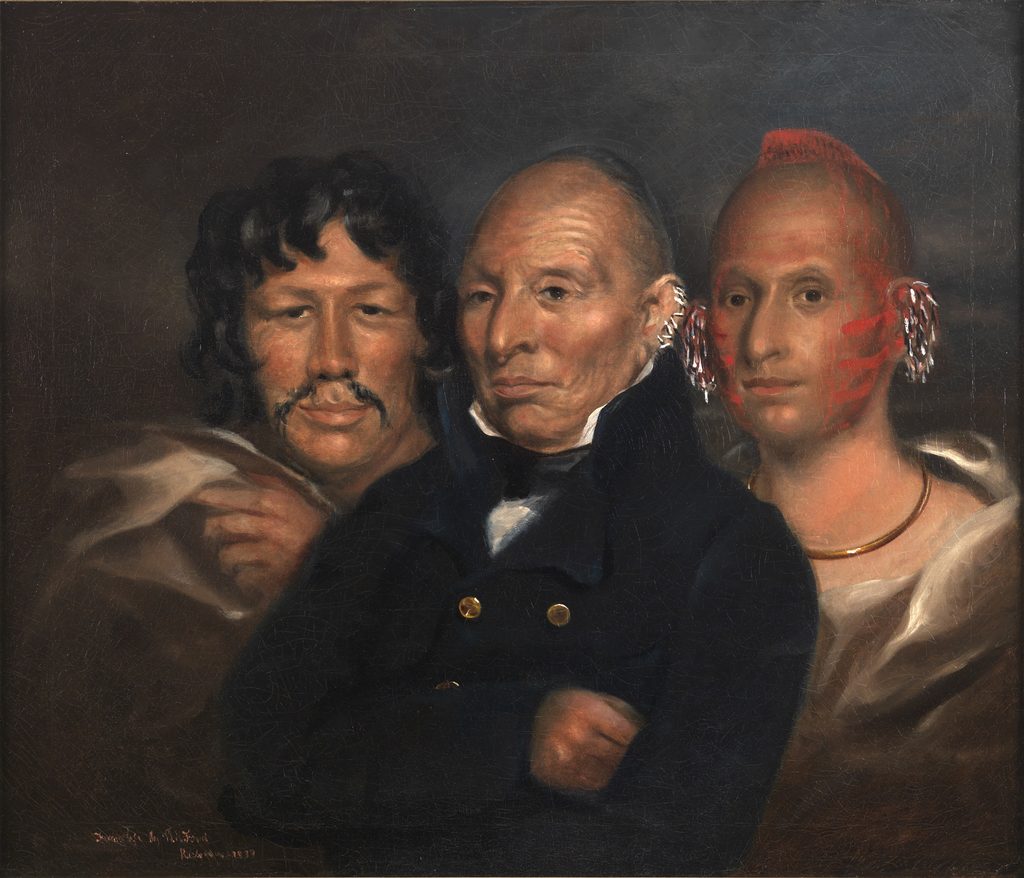
In the spring of 1833, the War Department sent Black Hawk and other captured men east. In Washington, D.C., Black Hawk met President Andrew Jackson; the men were then held at Fort Monroe in Virginia before being taken on a tour of eastern cities.26
The tour, the Library adds, was designed to show Black Hawk “the power and sheer number of his white enemies and the futility of further opposition to westward expansion.”26
Earlier, while Black Hawk was still in custody in the West, U.S. commissioners on September 21, 1832, concluded a new treaty with Sauk and Meskwaki leaders, including Keokuk, at Fort Armstrong.27
The treaty ceded a large tract west of the Mississippi in present-day eastern Iowa, known afterward as the Black Hawk Purchase. Article II reserved four hundred square miles along the Iowa River “for the use of the said confederated tribes,” laid out so as to include Keokuk’s principal village. The tract is often called Keokuk’s Reserve, but the treaty reserved it to the Sauk and Meskwaki, not to Keokuk personally.28
The war fought to keep land east of the Mississippi thus ended with the loss of land west of it.
The Autobiography and Its Mediation
Black Hawk’s Life, first published in 1833, is indispensable, but it should be read for what it is. Black Hawk did not write it in English. He dictated his account in Sauk to LeClaire, who interpreted it, and J. B. Patterson of Rock Island, named on the title page as “editor and proprietor,” prepared it for publication.29
The book is therefore evidence of Black Hawk’s account as it passed through an interpreter and an editor, not an unfiltered transcript. Civics for Life readers may recognize the problem from Thomas R. Gray’s Confessions of Nat Turner: a vital first-person source shaped by the people who recorded it.
The University of Tennessee Libraries, which holds a first edition, describes the book as “one of the first Native American autobiographies published in the United States.”30
Even with those limits, the autobiography did something no military report could. It placed a Sauk leader’s explanation of the 1804 treaty, the return to Illinois, and Bad Axe into a public record otherwise dominated by U.S. officers and settlers.
Black Hawk’s Final Years and the Nations Today
Black Hawk spent his last years in Iowa and died there on October 3, 1838, in present-day Davis County.31
The Sauk and Meskwaki faced further removals in the following decades. In the 1850s, Meskwaki families pooled their own annuity payments and, with the state’s consent, bought land in Tama County, Iowa, which became the Meskwaki Settlement.32
The first purchase, recorded in a deed dated July 13, 1857, was 80 acres bought with $1,000 of the Meskwaki’s own money. Because the land was purchased rather than assigned by the federal government, the Meskwaki Settlement has a distinctive history of land ownership and self-determination.4
Johnathan Buffalo, historic preservation director of the Meskwaki Nation, has put it plainly: “We are Meskwakis. We are Iowans, and we’re U.S. citizens.”4
The Sac and Fox Nation in Oklahoma and the Sac and Fox Nation of Missouri in Kansas and Nebraska also continue as self-governing nations. Each has its own history of the events of 1804 and 1832.
Legacy and Civic Relevance
The Black Hawk War is sometimes remembered as a brief frontier conflict or as an episode in the early careers of famous Americans. Its central question deserves more attention: who had the authority to give up Sauk land, and what did those who signed the 1804 and 1816 treaties understand they were agreeing to?
Black Hawk’s story also shows that Indigenous communities did not respond to U.S. power with one voice. Keokuk and Black Hawk drew different conclusions from the same circumstances, and both were trying to protect their people. And the war’s records, from Black Hawk’s dictated memoir to Atkinson’s official report, invite readers to compare accounts and consider whose version of events has usually been heard.
Together with the Haudenosaunee Confederacy’s continuing government and Tecumseh and Tenskwatawa’s intertribal alliance, Black Hawk’s challenge to the 1804 treaty shows that Indigenous nations met westward expansion with different political strategies, each shaped by its own history and its own understanding of who could speak for the land.
Explore more Native American history in Tecumseh and Tenskwatawa: Alliance Against U.S. Expansion, The Trail of Tears, The Indian Removal Act, Chief John Ross, Sequoyah and the Cherokee Syllabary, and a growing list in our History Lessons.
Endnotes
- Black Hawk, Life of Ma-ka-tai-me-she-kia-kiak, or Black Hawk, dictated by himself, interpreted by Antoine LeClaire, ed. J. B. Patterson (Cincinnati, 1833), LeClaire certificate (front matter, unpaginated); digital scan, Canadiana. https://www.canadiana.ca/view/oocihm.27473
- Black Hawk, Life of Black Hawk (1833), 72. https://www.canadiana.ca/view/oocihm.27473
- Iowa Department of Natural Resources, “Catfish Creek State Preserve.” https://iowadnr.gov/places-go/state-preserves/catfish-creek-state-preserve
- Iowa PBS, “The Meskwaki Nation’s Story of Survival, Land and Sovereignty in Iowa,” video with transcript, featuring Johnathan Buffalo, Historic Preservation Director, Meskwaki Cultural Center and Museum, and Eric Zimmer, author of Red Earth Nation. https://www.iowapbs.org/home/special/13969/meskwaki-nations-story-survival-land-and-sovereignty-iowa
- Sac and Fox Nation of Missouri in Kansas and Nebraska, “History of the Tribe.” https://sacandfoxks.com/
- “Treaty with the Sauk and Fox Indians, 3 November 1804,” editorial note, The Papers of Thomas Jefferson, vol. 45, Founders Online, National Archives. https://founders.archives.gov/documents/Jefferson/01-45-02-0272
- Black Hawk, Life of Black Hawk (1833), 28. https://www.canadiana.ca/view/oocihm.27473
- Sac and Fox Nation, “Archives” (transcription and images of the 1804 treaty). https://www.sacandfoxnation-nsn.gov/archives/
- Black Hawk, Life of Black Hawk (1833), 29. https://www.canadiana.ca/view/oocihm.27473
- Treaty with the Sauk, May 13, 1816, in Charles J. Kappler, ed., Indian Affairs: Laws and Treaties, vol. 2 (1904); Oklahoma State University Tribal Treaties Database. https://treaties.okstate.edu/treaties/treaty-with-the-sauk-1816-0126
- Black Hawk, Life of Black Hawk (1833), 70. https://www.canadiana.ca/view/oocihm.27473
- Patrick J. Jung, “Toward the Black Hawk War: The Sauk and Fox Indians and the War of 1812,” Michigan Historical Review 38, no. 1 (Spring 2012): 27–52, at 46.
- Jung, “Toward the Black Hawk War.”
- Jung, “Toward the Black Hawk War,” 50.
- Wisconsin Historical Society, “The Black Hawk War, 1832.” https://legacy.wisconsinhistory.org/Records/Article/CS464
- Jung, “Toward the Black Hawk War,” 41.
- Black Hawk, Life of Black Hawk (1833), 88–89. https://www.canadiana.ca/view/oocihm.27473
- Black Hawk, Life of Black Hawk (1833), 109–110. https://www.canadiana.ca/view/oocihm.27473
- Black Hawk, Life of Black Hawk (1833), 111. https://www.canadiana.ca/view/oocihm.27473
- Jung, “Toward the Black Hawk War,” 51.
- “Lincoln the Soldier,” Outdoor Illinois, January 2009, Illinois Department of Natural Resources. https://dnr.illinois.gov/content/dam/soi/en/web/dnr/oi/documents/jan09lincolnsoldier.pdf
- Wisconsin Historical Society, “The Black Hawk War,” Turning Points in Wisconsin History, essay. https://legacy.wisconsinhistory.org/turningpoints/tp-012/?action=more_essay
- Black Hawk, Life of Black Hawk (1833), 134. https://www.canadiana.ca/view/oocihm.27473
- Black Hawk, Life of Black Hawk (1833), 135. https://www.canadiana.ca/view/oocihm.27473
- Henry Atkinson to Winfield Scott, August 9, 1832 (“The Battle of Bad Axe: General Atkinson’s Account”), reproduced among the lesson documents in Wisconsin Historical Society, “The Black Hawk War, 1832.” https://legacy.wisconsinhistory.org/Records/Article/CS464
- Library of Virginia, Document Bank of Virginia, “Portrait of Black Hawk, 1833.” https://www.lva.virginia.gov/collections/educator-resources/dbva/items/show/292
- DigiTreaties, “Cession 175: Treaty with the Sauk and Foxes, September 21, 1832,” National Archives Office of Innovation and Museum of Indian Arts and Culture. https://digitreaties.org/treaties/cession/175/
- Treaty with the Sauk and Foxes, September 21, 1832, 7 Stat. 374, U.S. Statutes at Large, via GovInfo. https://www.govinfo.gov/link/statute/7/374
- Black Hawk, Life of Black Hawk (1833), title page and LeClaire certificate (front matter). https://www.canadiana.ca/view/oocihm.27473
- Jennifer Benedetto Beals, “First Edition of Black Hawk in UT Special Collections,” University of Tennessee Libraries, July 19, 2021. https://volumes.lib.utk.edu/features/first-edition-black-hawk
- University of Michigan Library, “Ma-ka-tai-me-she-kia-kiak (aka Black Hawk),” Great Native American Chiefs online exhibit. https://apps.lib.umich.edu/online-exhibits/exhibits/show/great-native-american-chiefs/group-of-native-american-chief/war-chief–black-hawk–aka-ma-
- State Historical Society of Iowa, “American Indian Removal and Relocation,” Primary Source Set. https://iowaculture.gov/history/education/educator-resources/primary-source-sets/american-indian-removal-and-relocation
Image Sources:
- Ma-Ka-Tai-Me-She-Kia-Kiah, or Black Hawk, a Saukie brave / A.H.
Bowen, John T., lithographer, Alfred M. Hoffy, Frederick W. Greenough, Thomas Loraine McKenney, and James Hall. *Ma-Ka-Tai-Me-She-Kia-Kiah, or Black Hawk, a Saukie brave / A.H.* Philadelphia: Published by F. W. Greenough, ca. 1838. Photograph. Library of Congress. https://www.loc.gov/item/2013645340/. - Black Hawk War Map
Wisconsin Historical Society, Black Hawk War Map, W014240, https://wisconsinhistory.org/record/map/W014240. The record lists no creator, a creation date of 1832–1899, and copyright status “No Copyright – United States.” - Portrait of Black Hawk, 1833
“Portrait of Black Hawk, 1833,” Document Bank of Virginia, accessed October 16, 2026, https://www.lva.virginia.gov/collections/educator-resources/dbva/items/show/292.