

Tecumseh and Tenskwatawa: Alliance Against U.S. Expansion
A prophet’s message, a town of many nations, and a disputed treaty raised a question on which U.S. officials and the brothers fundamentally disagreed: who had authority to cede Indigenous land?
In the spring of 1805, according to historian R. David Edmunds, a Shawnee man known as Lalawethika, a name meaning “rattle” or “noisemaker,” experienced a series of visions that he said came from the Master of Life.1
He took a new name, Tenskwatawa, meaning “the open door,” and began to preach.1
Within a few years, people from many nations had gathered around him and his older brother, Tecumseh, in a town on the Wabash River. Together the brothers led a movement that combined religious renewal, community-building, diplomacy, and military resistance, activities that overlapped rather than unfolding as a simple sequence.
Their story is often told as Tecumseh’s alone, with Tenskwatawa as a supporting character or a cautionary figure. The record supports a different account: the movement began with Tenskwatawa’s religious message, and Tecumseh’s political and military leadership developed alongside it. Neither brother’s role makes sense without the other’s.

Shawnee Homelands Under Pressure
The Eastern Shawnee Tribe of Oklahoma describes the original Shawnee homeland as “the middle Ohio Valley, between modern Louisville, Kentucky, and West Virginia.”2
By the late eighteenth century, Shawnee communities had endured decades of war, displacement, and repeated moves as settlers from Virginia, Pennsylvania, and Kentucky pushed into the Ohio country.
Tecumseh was born around 1768 in Shawnee country near present-day Springfield, Ohio.3
He grew up in a period of nearly continuous conflict between Shawnee communities and American settlers and militia, and he became known as a warrior while still young.
He fought against the United States in the wars of the early 1790s. At the Battle of Fallen Timbers in August 1794, according to Goltz, he headed a small party of Shawnee fighters.3
Afterward, he refused to accept the 1795 Treaty of Greenville, under which other Indigenous leaders ceded most of present-day Ohio.3
Tenskwatawa, born probably in 1775, grew up in the same turbulent world.1
In the years before his visions, Shawnee and neighboring communities faced shrinking hunting grounds, disease, alcohol brought by traders, and deep divisions over how to respond to the United States. Some leaders sought accommodation, annuities, and farming programs offered by federal agents. Others saw those programs as a path to losing everything.
Tenskwatawa’s Movement
A Message of Renewal
According to Edmunds, the visions showed him a paradise and a place of punishment, and he emerged urging followers to give up alcohol and return to the communal ways of their ancestors.1
He taught that Americans were the children of the Great Serpent, an evil power, rather than of the Master of Life, and he urged followers to renounce alcohol and many other products and practices associated with American influence.4
The message spread quickly. In the summer of 1805, Tenskwatawa founded a new village near Greenville in western Ohio, and people from several nations came to hear him.1
The movement also had a harsher side. Edmunds records that in March 1806, Tenskwatawa assisted Delaware participants in assessing accusations of witchcraft; four of the accused were subsequently burned at the stake.1
These events show that Tenskwatawa’s renewal movement was also a struggle over authority within Indigenous communities, including over leaders seen as too close to the Americans.
Prophetstown
In the spring of 1808, the brothers moved their followers west to a new town at the mouth of the Tippecanoe River, in present-day Indiana.1
One Smithsonian account estimates that the multinational population of Prophetstown, as Americans called it, reached about 3,000.4
The town made the movement’s collective ambitions visible. Chief Ben Barnes of the Shawnee Tribe has described how, when Tenskwatawa gathered followers near present-day West Lafayette, community members brought seeds from across the East to feed themselves. The result, he writes, was a speckled, multicolored corn that “reflected the multicultural community.”5
Barnes notes that a variety sold today as “Tecumseh” flint corn “is reportedly from Prophetstown during the time of the Prophet,” connecting it to Tenskwatawa’s town rather than to Tecumseh alone.5
Maintaining a town of many newly arrived followers was difficult. Food was often short, the movement sought provisions from outside, and Edmunds records that during the winter of 1808–1809 many people died.1
The Treaty of Fort Wayne and a Question of Authority
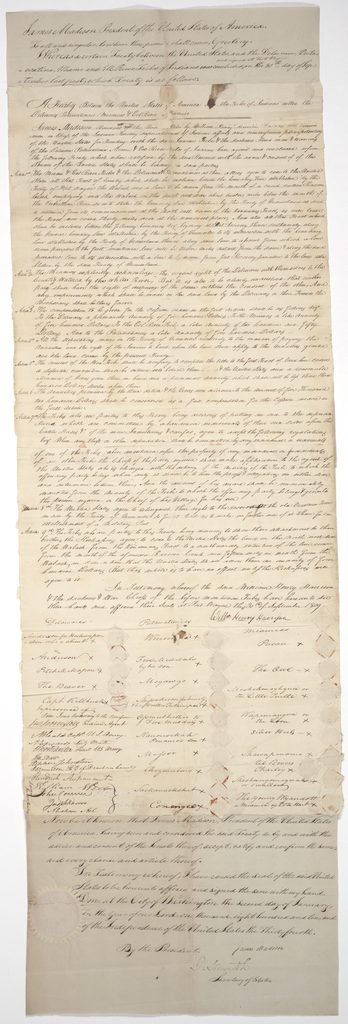
On September 30, 1809, Indiana Territory governor William Henry Harrison concluded a treaty at Fort Wayne with leaders of the Delaware, Potawatomi, Miami, and Eel River Miami.6
According to the Smithsonian’s National Museum of the American Indian, the treaty ceded about 2.5 million acres of tribal land.7
The treaty set out the payments in detail: permanent annuities of $500 each to the Delaware, Miami, and Potawatomi, $250 to the Eel River Miami, and $5,200 in goods delivered at the signing.6
The transaction was not as simple as a single signing. Article 5 stated that the consent of the Wea was necessary to complete title to the first tract ceded, to be secured in a separate convention. Article 9 added a further cession on the northwest side of the Wabash that would “have no effect unless the Kickapoos will agree to it.”6
Harrison presented the agreement as a valid purchase from leaders authorized to make it. Tecumseh argued that the agreement ceded land whose use and political significance extended well beyond the signatory communities.
Edmunds calls the treaty “a watershed” in Tenskwatawa’s career. After Fort Wayne, many followers looked increasingly to Tecumseh’s political and military leadership.1
The dispute was about more than acreage. Tecumseh rejected the idea that leaders of a few villages or nations could sell land that many peoples used and depended on. According to the Indiana Historical Bureau, he asserted that “Indian lands were common property and could not be sold without agreement of all Indian nations.”8
Harrison maintained that the signatory nations possessed authority to cede the land; Tecumseh rejected that premise. That disagreement over who held the authority to cede land sat at the center of everything that followed.
Tecumseh’s position did not prevail among all Indigenous leaders. Different nations and communities understood their authority to negotiate land agreements in different ways, while some leaders also faced pressure from U.S. officials or feared losing their own political standing within a broader alliance. Opposition to the brothers therefore reflected both U.S. pressure and real differences within Indigenous politics.
Tecumseh’s Diplomacy
Councils at Vincennes
Tecumseh met Harrison at Vincennes, the territorial capital, in August 1810 and again in July 1811.8
The first council was tense and produced no agreement.3
Readers should approach the speeches attributed to Tecumseh at these meetings with care. The National Constitution Center, which reproduces his August 20, 1810 speech at Vincennes from Harrison’s records, notes that “there are many versions of this speech, which was delivered orally.”9
What survives from the time are accounts written by Harrison and other Americans present. The polished versions of Tecumseh’s words that circulate widely today are best checked against those contemporary records before being treated as his own.
The Southern Journey
In 1811, Tecumseh traveled south to seek support among other nations for a broad alliance against further land cessions.3
His goal was ambitious: an alliance strong enough that no single nation’s leaders could be pressured into selling shared land. Responses varied. Some communities welcomed the message, while many leaders, weighing their own relationships with the United States and their own internal politics, declined to join.
Tippecanoe
While Tecumseh traveled south seeking allies, Harrison marched about 1,000 troops toward Prophetstown.4
Edmunds describes Tenskwatawa’s choice: “Rather than surrender his village and supplies, Tenskwatawa decided to attack.”1
Warriors from Prophetstown attacked Harrison’s camp before dawn on November 7, 1811, while, according to Edmunds, Tenskwatawa remained in the village praying for victory.1
Because the surviving accounts were largely produced by participants and observers with their own interests, historians must distinguish what the records establish from what they suggest about each side’s intentions.
Harrison’s force held its position, and the attackers withdrew. A Smithsonian account describes the battle as a stalemate that nonetheless demoralized the town’s defenders, after which Harrison burned Prophetstown and destroyed its food stores.4
The defeat sharply damaged Tenskwatawa’s religious authority, though he continued to take part in the movement and later tried to rebuild his following.1
Rebuilding
Prophetstown’s destruction did not end the movement. Edmunds records that a new village was built near the earlier site, and that Tenskwatawa remained with Tecumseh, assisting his brother’s efforts to unite the nations politically.1
Goltz concludes that “by June 1812 it was clear that the confederacy was at least as strong as before Tippecanoe.”3
Americans would later celebrate Tippecanoe in political campaigns. For the movement, the battle accelerated a military confrontation already developing through treaty disputes, British contacts, and Tecumseh’s diplomacy. Edmunds notes, for example, that Tenskwatawa had received several shipments of British provisions during the winter of 1810–1811.1
Alliance with Britain and the War of 1812
When war broke out between the United States and Britain in 1812, Tecumseh allied with the British. He took part in the capture of Detroit in August 1812 alongside Major General Isaac Brock, and in 1813, according to Goltz, he and the Wyandot leader Roundhead led about 1,200 Indigenous warriors during the siege of Fort Meigs in Ohio.3
The alliance is best understood as a strategic relationship pursued for Indigenous goals. For Tecumseh and his followers, British support offered a chance to halt American expansion and secure a lasting Indigenous homeland. For the British, Indigenous allies were essential to defending Upper Canada. The two sides’ aims overlapped, but they were not the same.
Tecumseh was not the only Indigenous leader to make this choice. Sauk warriors from the Upper Mississippi, among them a leader named Black Hawk, also fought alongside the British.10
The partnership was also marked by disagreement. When the British commander Henry Procter decided to abandon the Detroit frontier and retreat, Tecumseh objected publicly. His speech survives in the account of John Richardson, who served with the British forces and later wrote a history of the war; like other records of Tecumseh’s words, it reached print through translation and another person’s pen.11
Tecumseh’s objection did not change the decision, and Indigenous families who had relied on British promises were forced to retreat as well.
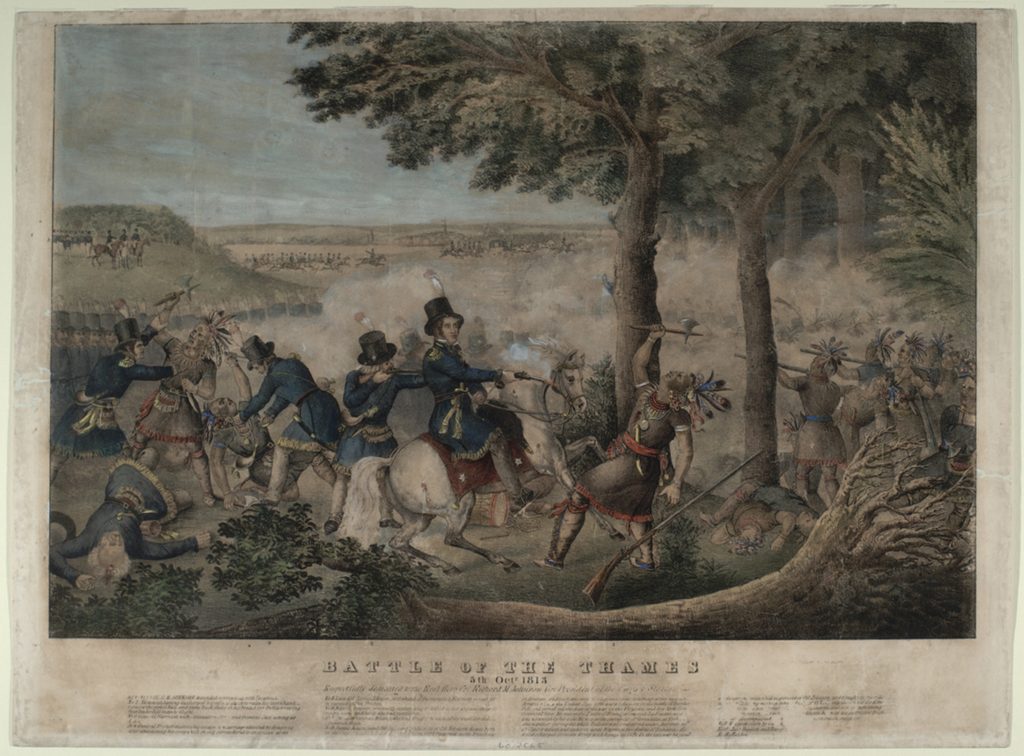
After the Americans won control of Lake Erie in 1813, Procter’s forces retreated into Upper Canada. Tecumseh was killed on October 5, 1813, at the Battle of the Thames near Moraviantown, in present-day Ontario. Who killed him, and where his remains lie, are unknown.3
Tenskwatawa After the War
Tenskwatawa outlived his brother by more than two decades. He spent years in Upper Canada with a small group of followers, and by 1817, according to Edmunds, they numbered only about two dozen Shawnee.1
In 1825 he returned to Wapakoneta, a Shawnee village in western Ohio, at the invitation of Michigan Territory governor Lewis Cass.1
Federal removal policy soon carried him west again. In October 1826 he left Ohio with about 250 Shawnee people. After wintering near Kaskaskia, Illinois, they crossed the Mississippi in August 1827, traveled into western Missouri, and reached the Shawnee reservation in eastern Kansas in the spring of 1828.1
Tenskwatawa died there in November 1836, in what is now Kansas City, Kansas.1
His full career, from visionary to town founder to exile to removed elder, is a reminder that the movement’s story did not end at the Thames.
Reading the Sources
Most of what survives about the brothers was written by people who opposed them or allied with them for their own purposes: Harrison and other American officials, British officers, missionaries, and traders. Very little was written by Shawnee people themselves at the time.
That imbalance has shaped how the brothers are remembered. Many later accounts cast Tecumseh as a noble, doomed hero while portraying Tenskwatawa as a fraud or fanatic. Historian R. David Edmunds, author of a book-length study of Tenskwatawa, challenged that pattern. In his Dictionary of Canadian Biography entry, he presents the Prophet’s religious movement as the foundation that Tecumseh later turned into a political and military alliance.1
Reading the brothers together, rather than one as the hero and the other as the foil, gives a fuller picture of how the movement worked. It also invites readers to ask how much of the familiar story reflects what happened and how much reflects who was doing the writing.
The Shawnee Nations Today
The Shawnee did not disappear with the defeat of the alliance. Today there are three federally recognized Shawnee tribes: the Absentee-Shawnee Tribe of Indians of Oklahoma, the Eastern Shawnee Tribe of Oklahoma, and the Shawnee Tribe.12
According to the Eastern Shawnee Tribe, the three are based near Shawnee, near Wyandotte, and in Miami, Oklahoma, respectively.2
The Absentee Shawnee Tribe, whose tribal government complex is in Shawnee, Oklahoma, features Tecumseh in its tribal logo, describing him as “a Shawnee warrior and visionary leader, who worked to unite tribes in a common homeland.”13
Shawnee leaders continue to interpret this history in their own terms, as Chief Barnes’s account of Prophetstown corn shows, connecting the multinational community the brothers built to present-day Shawnee resilience.
Legacy and Civic Relevance
Tecumseh and Tenskwatawa are often remembered through the eyes of their opponents: Harrison’s reports, American campaign slogans, and heroic or tragic legends written long after the fact. Returning to the sources reveals a more complicated story of shared leadership, community needs, disagreement, and resistance.
At its core was a question of political authority. U.S. officials treated treaties negotiated with recognized Indigenous leaders as binding. Tecumseh argued that no individual nation or group of leaders had the authority to cede lands whose use and protection concerned multiple nations. That disagreement raises questions still worth considering: Who has the authority to make binding decisions for a community? What happens when people affected by a decision have no voice in making it? And how should historians weigh records produced largely by one side of a conflict?
The movement also shows that Indigenous responses to U.S. expansion were political choices made by people with different goals, not a single, inevitable story. Some leaders signed treaties, some joined the brothers, and some tried to stay neutral.
One Sauk veteran of the British alliance would raise the question of treaty authority again two decades later, on the Upper Mississippi. His name was Black Hawk. Learn more about him in the companion article, Black Hawk: Sauk Homeland, a Contested Treaty, and the War of 1832.
Explore more Native American history in The Trail of Tears, The Indian Removal Act, Chief John Ross, Sequoyah and the Cherokee Syllabary, and a growing list in our History Lessons.
Endnotes
1. R. David Edmunds, “Tenskwatawa,” in Dictionary of Canadian Biography, vol. 7 (University of Toronto/Université Laval, 1988). https://www.biographi.ca/en/bio/tenskwatawa_7E.html
2. Eastern Shawnee Tribe of Oklahoma, “History.” https://www.estoo-nsn.gov/history
3. Herbert C. W. Goltz, “Tecumseh,” in Dictionary of Canadian Biography, vol. 5 (University of Toronto/Université Laval, 1983). https://www.biographi.ca/en/bio/tecumseh_5E.html
4. Molly Stephey and James Ring Adams, “Tecumseh’s War: The Road to 1812,” American Indian 13, no. 1 (Spring 2012), Smithsonian National Museum of the American Indian. https://www.americanindianmagazine.org/story/tecumsehs-war-road-1812
5. Chief Ben Barnes, “Messages from the Chiefs,” Shawnee Journal, May 2025, Shawnee Tribe. https://shawnee-nsn.gov/wp-content/uploads/2025/04/2025.05-May_Shawnee_Journal_Redacted.pdf
6. Treaty with the Delawares, etc., September 30, 1809, 7 Stat. 113, in Charles J. Kappler, ed., Indian Affairs: Laws and Treaties, vol. 2 (Washington, DC: Government Printing Office, 1904), 101–102; digitized copy hosted by the Smithsonian National Museum of the American Indian, Nation to Nation. https://americanindian.si.edu/nationtonation/pdf/Treaty-of-Fort-Wayne-1809.pdf
7. National Museum of the American Indian, “The Treaty of Fort Wayne, 1809—a Treaty That Led to War—Goes on Exhibit,” September 29, 2017. https://americanindian.si.edu/collections-search/object/posts_712a27a162ac1160a0d350300f47f1c8
8. Indiana Historical Bureau, “Tecumseh and Harrison,” Indiana State Historical Marker. https://www.in.gov/history/state-historical-markers/find-a-marker/tecumseh-and-harrison/
9. National Constitution Center, “Tecumseh, Chief of the Shawnee, Speech at Vincennes (August 20, 1810),” Historic Document Library, from Governors Messages and Letters, Indiana Historical Collections (1922), vol. 1, 463–68. https://constitutioncenter.org/the-constitution/historic-document-library/detail/tecumseh-chief-of-the-shawnee-speech-at-vincennes-august-20-1810-from-governors-messages-and-letters-indiana-historical-collections-1922-vol-1-pp-463-68
10. Patrick J. Jung, “Toward the Black Hawk War: The Sauk and Fox Indians and the War of 1812,” Michigan Historical Review 38, no. 1 (Spring 2012): 27–52.
11. “Tecumseh’s Speech to Procter, as Reported by John Richardson,” from John Richardson, Richardson’s War of 1812, 205–206, Windsor Public Library digital collection. https://projects.windsorpubliclibrary.com/digi/war1812/contents/retreat/tecumsehspeech.htm
12. Bureau of Indian Affairs, “Indian Entities Recognized by and Eligible To Receive Services From the United States Bureau of Indian Affairs,” Federal Register 91, 4102 (January 30, 2026). https://www.federalregister.gov/d/2026-01899
13. Absentee Shawnee Tribe of Indians of Oklahoma, official website. https://www.astribe.com/
Image Sources:
- Ten-sqúat-a-way, The Open Door, Known as The Prophet, Brother of Tecumseh, by George Catlin, 1830
George Catlin, Ten-sqúat-a-way, The Open Door, Known as The Prophet, Brother of Tecumseh, 1830, oil on canvas, 29 x 24 in. (73.7 x 60.9 cm), Smithsonian American Art Museum, Gift of Mrs. Joseph Harrison, Jr., 1985.66.279. https://americanart.si.edu/artwork/ten-squat-way-open-door-known-prophet-brother-tecumseh-4301 - Treaty of Fort Wayne, 1809
Smithsonian National Museum of the American Indian, Nation to Nation, “Treaty of Fort Wayne, 1809.” https://americanindian.si.edu/nationtonation/treaty-fort-wayne-1809.html - Video: The village at Prophetstown State Park, Indiana Department of Natural Resources
Indiana Department of Natural Resources, “The village at Prophetstown State Park,” video. https://youtu.be/0t3cOXEegiE?si=J_s51rnDtWuXaleR - Battle of the Thames, lithograph by Edward Weber
Edward Weber (maker), Battle of the Thames, lithograph, n.d., image 13 1/2 x 20 1/4 in. National Museum of American History, Harry T. Peters “America on Stone” Lithography Collection, DL.60.2565. https://americanhistory.si.edu/collections/object/nmah_324884