

The Haudenosaunee Confederacy: Nations United by the Great Law of Peace
How distinct nations built a shared system of government, and how that government has continued through colonial rivalry, revolution, and the westward growth of the United States.
Each November, an annual commemoration in Canandaigua, New York, marks the continuing treaty relationship between the Six Nations and the United States under a treaty signed in that town on November 11, 1794.1
Organizers describe the gathering as a way to “polish the chain of peace and friendship” between the Six Nations and the United States.1
That annual ceremony points to something easily lost in histories of American expansion. The Haudenosaunee Confederacy did not end as the United States grew westward. Its traditional governing institutions continue, alongside the governments of its member nations, and it maintains a continuing treaty relationship with the United States under agreements that remain in effect.
The Haudenosaunee Confederacy, also known historically in English as the Iroquois Confederacy, was formed by five nations: the Mohawk, Oneida, Onondaga, Cayuga, and Seneca.2
A sixth nation, the Tuscarora, joined in the eighteenth century, which is why the Confederacy is often called the Six Nations. The story of how these nations created a shared government, kept it working through centuries of pressure, and dealt with the young United States as it pushed west is an important case study in American civic history.
Who the Haudenosaunee Are
According to the Smithsonian’s National Museum of the American Indian, Haudenosaunee (pronounced hoe-dee-no-SHOW-nee) means “people who build a house.”3
The name reflects the longhouse, the traditional multifamily dwelling, and a confederacy understood as many families and nations sheltering under one roof. Each member nation has its own language, communities, leaders, and history. The Confederacy joined them for common purposes without erasing those distinctions. That distinction still matters today: the traditional Confederacy and the governments of its member nations are related but not interchangeable.
Haudenosaunee society is organized by clans, and those clans are matrilineal, meaning that children belong to their mother’s clan.3
That structure matters for understanding Haudenosaunee government. Clan Mothers hold recognized offices with responsibilities for clan welfare, leadership selection, and accountability, as described below.
The Great Law of Peace
The Peacemaker’s Message
The Confederacy’s own account of its creation begins in a time of conflict among the nations. According to that account, the Creator sent a figure known as the Peacemaker to spread the “Kariwiio or good mind.”4
The Peacemaker traveled with Hiawatha (Aiionwatha), and together they persuaded the leaders of the five nations to accept a Great Law of Peace.4
At Onondaga, the account continues, the Peacemaker planted a tree and named it the Great Tree of Peace, with roots called the Great White Roots extending outward in every direction. An eagle was placed above the tree to “see far and alert the confederacy of approaching enemies,” and the leaders were asked to throw their weapons beneath it “to bury any greed, hatred and jealousy.”4
The Peacemaker also took strings of wampum, shell beads strung or woven together, “one for each of the laws of the Great Peace.”4
Wampum remains central to Haudenosaunee record-keeping and diplomacy. The Smithsonian educator guide describes the Hiawatha Belt as a symbol of “the unity of the original five Haudenosaunee nations, connected by the Great Law of Peace,” with each white square and the central tree representing one of the five.3
These accounts are more than origin stories. They are the Confederacy’s own explanation of its founding principles, carried forward through oral tradition, ceremony, and wampum, and they continue to guide how the Confederacy understands its authority. They are presented here as the Confederacy tells them.
When Was the Confederacy Founded?
No one can say with certainty. The Confederacy states that “the exact date of the joining of the nations is unknown and said to be time immemorial.”2
By the time European traders and colonists arrived in the region in the early seventeenth century, the Confederacy was already a functioning political alliance, and it later expanded. According to the Smithsonian, members of the Tuscarora Nation traveled north from present-day North Carolina in 1722 to seek refuge among the Haudenosaunee and were invited to join the Confederacy as its sixth nation.3

How the Confederacy Governs
The Grand Council
Under the Great Law, the traditional Grand Council has fifty chiefly titles allocated among the original five nations. According to the Confederacy, the Mohawk and Oneida each hold nine, the Onondaga fourteen, the Cayuga ten, and the Seneca eight.4
The Confederacy describes the council’s procedure in detail. The original nations are grouped as Elder Brothers (the Mohawk, Onondaga, and Seneca) and Younger Brothers (the Cayuga and Oneida).5
Debate begins with the Mohawk and Seneca. Once they agree, the matter is “thrown across the fire” to the Oneida and Cayuga, then returned to the Elder Brothers, and finally presented to the Onondaga, who serve as Fire Keepers and may raise objections only if they believe a proposal is inconsistent with the Great Law.5
The Tuscarora joined the Confederacy without adding to its fifty chiefly titles, and the Confederacy describes their participation differently from that of the original five nations. According to its account, the Tuscarora do not hold a voice of their own in the Grand Council, and issues they raise are “voiced through the Cayugas.”5
The system emphasizes deliberation among the member nations and the Onondaga Fire Keepers rather than decision-making by simple numerical majority. Below the Grand Council, according to The Canadian Encyclopedia, “the individual communities and villages were governed by councils of their own sachems and Chiefs.”6
Clan Mothers and Accountability
Leadership under the Great Law is tied to the clans. According to the Confederacy, a Clan Mother chooses a candidate for chiefly office and presents him to her nation. He must then be approved by the brother nation and by the rest of the Grand Council before a Condolence ceremony raises him up as chief.5
If a chief acts improperly, his Clan Mother and Faith Keepers warn him. If the conduct continues, the Clan Mother may symbolically remove “his antlers,” ending his authority as chief.5
The Confederacy’s creation account describes the Clan Mother’s role as keeping a chief to his “moral obligations” and keeping “him in a straight line.”4
This arrangement divides political responsibility in a way that has drawn wide interest. Chiefs speak in council, but Clan Mothers initiate both selection and removal, and installation requires approval that links each leader to his clan, his nation, and the Confederacy as a whole.
Diplomacy Among Empires
The Confederacy’s diplomatic system faced new challenges after European powers entered the region. The Smithsonian’s educator guide dates the Two Row Wampum agreement with the Dutch to 1613. In Haudenosaunee diplomatic tradition, its two parallel rows express two peoples traveling side by side, each in its own vessel, neither steering the other.3
That image of parallel, equal relationships has remained central to how the Haudenosaunee describe their dealings with European and later American governments.
Through the seventeenth and eighteenth centuries, the Haudenosaunee dealt with Dutch, French, and English colonial powers, and later British imperial officials. That diplomacy was neither simple nor unanimous. According to The Canadian Encyclopedia, the Mohawk at times fought as English allies while the Seneca at times fought alongside French armies, and some Haudenosaunee converted to Catholicism and settled along the St. Lawrence.7
Even so, the Confederacy adapted, negotiated, and preserved a large measure of political and cultural autonomy through generations of war and trade.
Colonial figures took notice. In 1751, Benjamin Franklin, commenting to New York printer James Parker on a manuscript essay about Indian relations and colonial cooperation, argued that “it would be a very strange Thing, if six Nations of ignorant Savages should be capable of forming a Scheme for such an Union,” yet the English colonies could not.8
Franklin’s language reflected the prejudices of his time, and his point was aimed at the colonies rather than at the Haudenosaunee. The letter is evidence of how Franklin was thinking about colonial union in 1751. It is not, by itself, proof that particular features of the Great Law were borrowed for the Constitution in 1787.
The American Revolution Divides the Confederacy
The American Revolution put the Great Law’s commitment to consensus under severe strain. According to the National Park Service, “the majority of the Confederacy ultimately chose to continue their support of England,” while most of the Oneida and some Tuscarora supported the American cause.9
Loyalties also varied within nations and communities, and the war set Haudenosaunee against Haudenosaunee. At the Battle of Oriskany on August 6, 1777, Oneida warriors served alongside American militia against British-allied members of other Six Nations.9
In 1779, General George Washington ordered the Clinton-Sullivan campaign into Haudenosaunee country with the aim, in the National Park Service’s words, “to completely destroy the principal villages and food supplies of the Cayuga and Seneca Indian Nations.”10
By the campaign’s end, the Park Service reports, the army had destroyed more than forty villages and at least 160,000 bushels of corn.10
Thousands of displaced people sought British assistance; by September 21, 1779, according to the same account, 5,036 had gathered at Fort Niagara.10
When the war ended, Britain’s 1783 peace treaty with the United States made no provisions for its Haudenosaunee allies.10
The Confederacy now had to deal directly with new republic that claimed much of its land by right of conquest. Alliance with the winning side did not protect the Oneida either: according to the Park Service, New York State later acquired most of the Oneida Nation’s remaining land in New York.9
Treaties and the Westward Push
Fort Stanwix, 1784
In October 1784, U.S. commissioners met Haudenosaunee delegates at Fort Stanwix, in present-day Rome, New York. The treaty’s opening language set the tone: “The United States of America give peace to the Senecas, Mohawks, Onondagas and Cayugas, and receive them into their protection upon the following conditions.”11
Those conditions included six hostages to be held until prisoners taken during the war were returned. The treaty also established a U.S.–Six Nations boundary and secured a cession of lands claimed by the Six Nations west of that line, while it stated that “the Oneida and Tuscarora nations shall be secured in the possession of the lands on which they are settled.”11
That cession covered territory in the Ohio country, but it was an agreement between the United States and the Six Nations alone. It did not settle the territorial rights or consent of the many other Indigenous nations living in or using those lands. Those questions would become central to later resistance in the Ohio country: who could authorize a land cession, and whose consent was required?11
Canandaigua, 1794
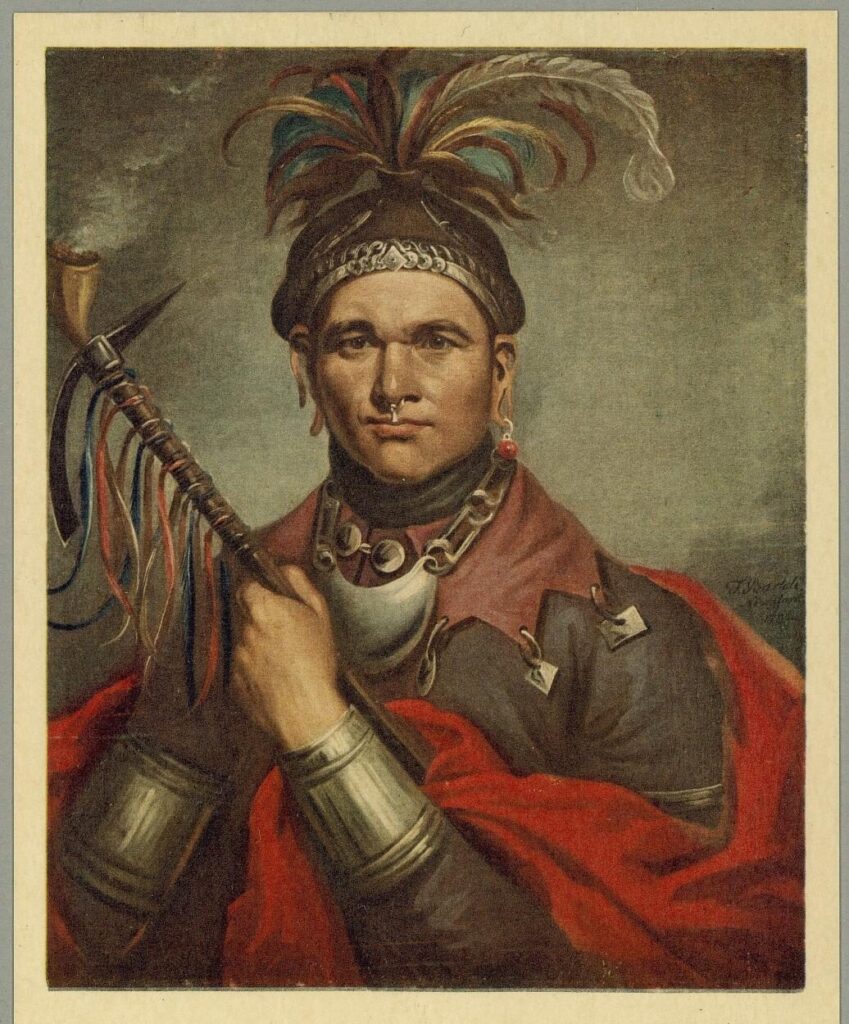
A decade later, the relationship took a different form. On November 11, 1794, more than fifty Haudenosaunee chiefs and sachems, including the Seneca leaders Cornplanter and Red Jacket, signed a treaty at Canandaigua with Timothy Pickering, President Washington’s representative.12
The treaty established “perpetual” peace and friendship between the United States and the Six Nations. In Articles II and III, the United States acknowledged specified Oneida, Onondaga, Cayuga, and Seneca lands as their property and promised never to claim them or disturb their use. In Article IV, the Six Nations reciprocally agreed that they would “never claim any other lands within the boundaries of the United States.”13
Article VI established an annual provision totaling $4,500 for clothing, domestic animals, farming implements, and other assistance. The treaty thus combined territorial guarantees, limits on further claims, and a continuing federal obligation, not simply a one-time settlement.13
According to the National Archives, the treaty “returned substantial tracts of land to the Haudenosaunee, which it had lost a decade earlier,” and the Senate approved it in January 1795.12

Did the Great Law Influence the U.S. Constitution?
Few questions about the Haudenosaunee draw more public attention, and few require more care. The documented evidence and the competing interpretations are worth separating.
Some points are well established. Franklin and other colonial figures knew of the Confederacy, and, as his 1751 letter shows, Franklin at times pointed to it as an example of union. In 1988, during bicentennial commemorations of the Constitution, Congress passed a resolution acknowledging “the contribution made by the Iroquois Confederacy and other Indian Nations to the formation and development of the United States.”14
That resolution also stated that “the confederation of the original Thirteen Colonies into one republic was influenced by the political system developed by the Iroquois Confederacy.”14
The resolution is a congressional acknowledgment, not a scholarly judgment that settles the historical debate. The Confederacy itself states that its constitution “is believed to be a model for the American Constitution.”2
Historians disagree about how far any influence extended. Scholars such as Donald A. Grinde Jr. and Bruce E. Johansen have argued that Haudenosaunee political ideas helped shape American thinking about political union and government. In a 1990 essay, they framed the issue as “a question of how this influence was conveyed,” arguing that the founders “examined all the examples they could find, and then fashioned their own.”15
Others, notably anthropologist Elisabeth Tooker, have argued that European political theory and precedent furnished the models for the American founders and that the evidence for Indian influence was thin. Critics also point to fundamental differences between the two systems, such as clan mothers’ role in choosing leaders and the League’s lack of a centralized authority like the federal government’s.16
It helps to separate two claims. One is that the Confederacy influenced colonial ideas about union, a claim Franklin’s letter supports well. The other is that the framers borrowed specific constitutional mechanisms from the Great Law in 1787, which remains disputed. What does not depend on resolving the debate is the Confederacy’s significance on its own terms: a constitutional order that predates the United States, operates by different principles, and whose traditional institutions continue.
A Continuing Government
The Haudenosaunee did not disappear from their homelands or from history. According to the Smithsonian, they “continue to live on territories and reservations in upstate New York and Wisconsin, in communities in Oklahoma and North Carolina, and in territories and on reserves in Ontario and Quebec, Canada.”3
The Confederacy continues to describe its traditional Grand Council, chiefs, and Clan Mothers as working institutions, along with committees on matters such as repatriation and wildlife and habitat.5
Those traditional institutions exist alongside the governments of individual nations and communities, which have their own governmental arrangements. Describing present-day Haudenosaunee government therefore requires attention to the particular nation and jurisdiction.
The Treaty of Canandaigua remains part of the Six Nations’ continuing relationship with the United States, and treaty cloth serves as a material acknowledgment of it. According to Ganondagan State Historic Site, “the United States each year provides $4500 for the annual distribution of cloth to the Six Nations peoples.”17
Writing in Two Row Times in 2013, Skaruianewah Logan reported that many elders say the cloth should still be collected “even if [it] becomes the size of a postage stamp, because this means our treaty is still alive.”18
Peter Jemison, a Seneca and the founding manager of Ganondagan State Historic Site, has described the annual rededication as “an important reminder to the U.S. that treaties are the supreme law of the land, and that this treaty continues to be valid and in effect.”1
Legacy and Civic Relevance
The Haudenosaunee Confederacy offers a rare chance to study a government built on principles very different from those most Americans learn in school: deliberation that moves among nations rather than majority vote, leaders chosen and removed through clan relationships, and a union of nations that preserves each nation’s identity.
It also raises questions that remain open. How can distinct nations share a government without surrendering their own? What does consensus demand of leaders, and what happens when a crisis like the American Revolution makes consensus impossible? And what does a continuing treaty relationship mean when land has been lost, and governments on both sides have changed?
Readers who consult the Confederacy’s own materials, the treaties themselves, and the scholarship cited here will find room for different answers. Those materials share one point: the Haudenosaunee story is not only about the past. The chain polished at Canandaigua each November is a present-day relationship between governments.
The 1784 Fort Stanwix treaty established a U.S.–Six Nations boundary and included a Six Nations land cession west of that boundary, but it did not settle the territorial claims of other Indigenous nations. A generation later, in the Ohio country, the Shawnee brothers Tecumseh and Tenskwatawa would challenge whether any group of leaders could give away land that many nations used and held in common.
Explore more Native American history in Tecumseh and Tenskwatawa: Alliance Against U.S. Expansion, The Trail of Tears, The Indian Removal Act, Chief John Ross, Sequoyah and the Cherokee Syllabary, and a growing list in our History Lessons.
Endnotes
1. Ganondagan State Historic Site and Friends of Ganondagan, “Canandaigua Treaty Commemoration.” https://ganondagan.org/canandaigua-treaty-commemoration
2. Haudenosaunee Confederacy, “Who We Are.” https://www.haudenosauneeconfederacy.com/who-we-are/
3. Smithsonian National Museum of the American Indian, Haudenosaunee Guide for Educators (Washington, DC: NMAI Education Office). https://americanindian.si.edu/sites/1/files/pdf/education/HaudenosauneeGuide.pdf
4. Haudenosaunee Confederacy, “Confederacy’s Creation.” https://www.haudenosauneeconfederacy.com/confederacys-creation/
5. Haudenosaunee Confederacy, “Confederacy Structure.” https://www.haudenosauneeconfederacy.com/government/
6. Peter G. Ramsden, updated by Zach Parrott, “Haudenosaunee (Iroquois),” The Canadian Encyclopedia, last edited May 15, 2024. https://www.thecanadianencyclopedia.ca/en/article/iroquois
7. Ramsden and Parrott, “Haudenosaunee (Iroquois).” https://www.thecanadianencyclopedia.ca/en/article/iroquois
8. Benjamin Franklin to James Parker, March 20, 1751, Founders Online, National Archives. https://founders.archives.gov/documents/Franklin/01-04-02-0037
9. National Park Service, “The Oneida Nation in the American Revolution,” Fort Stanwix National Monument. https://www.nps.gov/articles/the-oneida-nation-in-the-american-revolution.htm
10. National Park Service, “The Clinton-Sullivan Campaign of 1779.” https://www.nps.gov/articles/000/the-clinton-sullivan-campaign-of-1779.htm
11. Treaty with the Six Nations, October 22, 1784, 7 Stat. 15, in Charles J. Kappler, ed., Indian Affairs: Laws and Treaties, vol. 2 (Washington, DC: Government Printing Office, 1904); treaty text via University of Groningen, American History documents collection. https://www.let.rug.nl/usa/documents/1776-1785/treaty-with-the-six-nations-fort-stanwix-october-22-1784.php
12. National Archives, “Indian Treaties at the Museum of the American Indian,” The Text Message blog (Prologue), October 10, 2014. https://prologue.blogs.archives.gov/2014/10/10/indian-treaties-at-the-museum-of-the-indian-museum/
13. “Treaty Between the United States and the Six Nations Signed at Konondaigua, New York, with the Instrument of Ratification Signed by President George Washington and Secretary of State Edmund Randolph on January 21, 1795”, Indian Treaties, 1789–1869, National Archives, National Archives Catalog, NAID 12013254. https://catalog.archives.gov/id/12013254
14. H. Con. Res. 331, 100th Congress, agreed to October 21, 1988, “Iroquois Confederacy and Indian Nations—Recognizing Contributions to the United States,” via University of Nebraska–Lincoln, Teaching Legal History. https://teachinglegalhistory.unl.edu/s/oer/item/2056
15. Bruce E. Johansen and Donald A. Grinde Jr., “The Debate Regarding Native American Precedents for Democracy: A Recent Historiography,” American Indian Culture and Research Journal 14, no. 1 (1990): 61–88, eScholarship, University of California. https://escholarship.org/uc/item/8838h24v
16. TeachingHistory.org, “Iroquois and the Founding Fathers,” Ask a Historian, Roy Rosenzweig Center for History and New Media. https://teachinghistory.org/history-content/ask-a-historian/24099
17. Ganondagan State Historic Site, “Canandaigua Treaty.” https://ganondagan.org/Learning/Canandaigua-Treaty
18. Skaruianewah Logan, “Polish the Silver Covenant Chain of Friendship,” Two Row Times, November 13, 2013. https://tworowtimes.com/news/national/polish-silver-covenant-chain-friendship/
Image Sources
- Map of the Country of the VI Nations (1771 map, 1851 printing)
Lionel Pincus and Princess Firyal Map Division, The New York Public Library. “To his excellency William Tryon Esqr., captain general & governor in chief of the province of New-York & &: This map of the country of the VI. nations proper, with part of the adjacent colonies is humbly inscribed.” New York Public Library Digital Collections. Accessed October 16, 2026. https://digitalcollections.nypl.org/items/99d020e0-34b7-0134-fc9c-00505686a51c - The Treaty of Canandaigua, 1794
“Treaty Between the United States and the Six Nations Signed at Konondaigua, New York, with the Instrument of Ratification Signed by President George Washington and Secretary of State Edmund Randolph on January 21, 1795”. Indian Treaties, 1789–1869 (NAID 299798). National Archives Catalog, NAID 12013254. https://catalog.archives.gov/id/12013254 - Cornplanter, Seneca Chief, 1796 print
National Museum of Natural History, Smithsonian Institution. “Smithsonian Learning Lab Resource: Cornplanter, Seneca Chief 1796 Print.” Smithsonian Learning Lab, Smithsonian Office of Educational Technology, 28 Oct. 2015. https://learninglab.si.edu/q/r/15014